


The incredible Israeli Shekel, as Israels economy continues to Boom
Economics / Israel May 08, 2007 - 06:45 PM GMTBy: Gary_Dorsch
 In a speech to business people on the risks facing the global economy, former US Treasury Secretary Lawrence Summers said on March 20th, that geopolitics was at the top of his list. “There is a near complete disconnect between geopolitical risk and risk that is priced and perceived in financial markets. It's like something out of Dickens, you talk to international relations experts and it's the worst of all times. Then you talk to potential investors and it's one of the best of all times.”
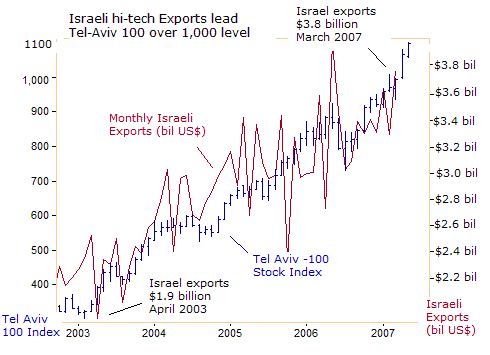
Nowhere is the disconnect between reality and illusion more vast than in Tel Aviv, where the “Incredible” Israel shekel is climbing to seven-year highs against the US dollar, flirting with the psychological 25 US-cents level, or 4 shekels per US dollar. Also, the Tel-Aviv 100 Index hit an all-time high of 1,100 on May 3rd, more than tripling in value from four years ago, after Israel's economy expanded at an 8% rate in Q'4, exceeded only by emerging giants in China, India, and Russia.
The “Incredible” Israeli shekel's climb to 25 US-cents comes amid reports that Syria is positioning thousands of missiles on its border with Israel. Iran and Syria have restocked Hizbullah with thousands of missiles and rockets in defiance of UN resolutions, and Sheik Nasrallah is once again capable of striking Tel-Aviv. Iranian backed Hamas has transferred tons of explosives and missiles into the Gaza Strip and is firing kassam rockets into southern Israel on a daily basis.
Iran's deputy interior minister is explicitly warning that in the event of an American attack on its nuclear installations, Iran would fire tens of thousands of missiles at Israel. Global investing always involves geo-political risks, and nowhere are the stakes higher than in the nine miles between the West Bank and the Mediterranean Sea.
To make matters worse, Ehud Olmert, the Israeli Prime Minister, was blasted by an investigative commission last week, of a “serious failure in exercising judgment, responsibility and prudence during the war last year against Lebanon.” The severe trashing of Olmert was surprising, since the Winograd commission was appointed by Olmert himself, and political analysts had expected a government white wash.
 Following Winograd's stinging rebuke, Olmert's popularity rating in one poll fell to an all-time low of just 2%, and another found 70% of Israeli voters want him to quit. Yet Olmert's weakness is also his strength, since members of his ruling Kadima party, and other coalition members are terrified of a new election, in which the right wing Likud party, headed by Benjamin Netanyahu, would be swept into power.
It was Netanyahu's economic blueprint in 2003 that set a 5-year time-table for lowering the Israeli corporate income tax rate from 35% to 25%, and set in motion the Tel-Aviv-100's four-year bull market. Under finance chief Netanyahu, Israel eliminated corporate and dividend taxes for foreign investments of more than one billion shekels ($200 million) by multinationals. It was also Netanyahu who converted the shekel into a free-floating currency in 1997.
“This is just a message that we are very eager to pull in investments and we are willing to go the distance, probably even more than any other country right now in the world,” said Netanyahu in April 2004. He laid out his vision of Israel as a land-bridge between Asia and Europe, competing with the Suez Canal by building a rail line between its Ashdod Port on the Mediterranean Sea and Eilat on the Red Sea.
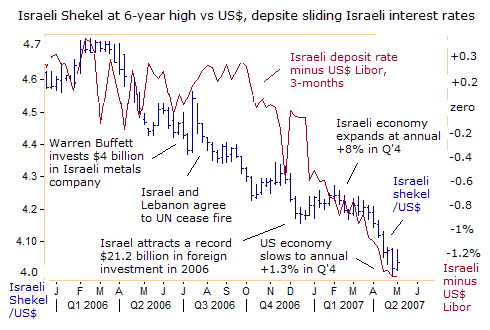
Interest rates differentials often play a key role in determining the direction of exchange rates. So what makes the “Incredible” Israeli shekel such an enigma is its unrelenting strength in the face of sharply lower Israeli interest rates, which have moved to an all-time low compared to US dollar deposit rates. Israeli shekel deposits yield 125 basis points less than comparable US dollar Libor rates. That's surprising, since the shekel has yielded as much as 6% more than the dollar this decade, to compensate foreign investors for the risk of sudden shekel devaluation.
Since January 2006, the US dollar has tumbled by 15% to 4-shekels, while at the same time Israeli deposit rates fell 160 basis points compared to US Libor yields. Israel's 31-day war with Hizbollah last summer, sparked a knee-jerk US dollar surge of 5% to 4.55 shekels, but in hindsight, it was only a counter-trend blip, and an opportunity to short the dollar at better levels. Israel's economy barely missed a beat, slipping just -0.7% in Q'3, before roaring back to +8% in Q'4.
For all of 2006, Israel's 624 billion shekel economy ($150 billion) grew by 5.1%, similar to 2005's growth spurt of 5.2%, and posted a current account surplus of $6.8 billion, or 5% of gross domestic product last year. Following a deep recession in 2003, Israel's economy has grown about 5% for the past three years and the central bank forecasts 5% growth in 2007. Industrial output surged 10.5% higher last year, exceeded only by emerging powerhouses in China, India, and Russia.
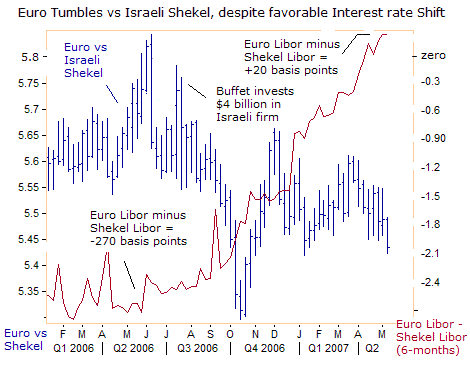
One could argue that the Israeli shekel's strength is simply a reflection of generalized US dollar weakness across the globe. But there appears to be more below the surface that explains the shekel's strength. The Euro has also lost 3.5% against the shekels over the past sixteen months, even as Euro Libor yields have surged 290 basis points higher, when compared to Israeli shekel deposit rates. For the first time in history, the shekel yields 20 basis points less than the Euro.
What lurks below the surface is a record flow of foreign capital into Israel's economy and capital markets, totaling $21.2 billion last year . In June 2006, the Oracle of Omaha, Warren Buffet of Berkshire Hathaway purchased an 80% share in Iscar, an Israeli metalworking company, for $4.1 billion, his first acquisition outside of the US. “With this purchase, we are sending an indirect message to the world for foreign investors to make similar investments,” said Charlie Munger, Buffet's partner at Berkshire Hathaway.
“Berkshire Hathaway and Israel will be here forever, as Israel and the US will be here forever,” said Buffet himself. Several weeks later, US billionaire Donald Trump declared, “I am confident that Israel's future can only go in one direction, and that is up.” Trump purchased a site in upscale Ramat Gan to build the 70-story “Trump Plaza Tower," next to the Israel Diamond Exchange, for $300 million. Trump also plans to build a 647-room resort hotel in the coastal town of Netanya.
Israeli exporters are worried about the shekel's strength against the Euro and the US dollar, which account for roughly 80% of sales abroad. Bank of Israel chief Stanley Fischer is under heavy pressure to either cut interest rates or buy US dollars in the currency market to try to weaken the Israeli currency. Since last October, the BoI has lowered the rate by 175 basis points, with the last quarter-point rate cut to 3.75% initiated on April 22nd, but Fischer has ruled out FX intervention.
“The Bank of Israel is very limited in intervening in the weakness of the dollar. No one at the central bank or the Treasury can influence the exchange rate,” said Finance deputy Yoram Ariav on April 30th. He said exporters are losing their competitive edge around the world due to the strong shekel but, “This is the price of being part of the global economy. The exchange rate shows the strength of the Israeli economy and that we have a positive current account,” he said.
Although Israel's economy is expected to grow by about 5% for a fourth straight year, its consumer inflation rate was 0.9% lower in March than a year ago. That's because housing and imported goods, which make up about 30% of the consumer price index are priced in US dollars. So a weaker US dollar keeps import prices in check while lowering the cost of housing. That puts the Bank of Israel in a sweet spot, as it can afford to lower interest rates further to cushion the dollar's slide, and at the same time, buoy Tel-Aviv-100 blue chips above the psychological 1000-level.
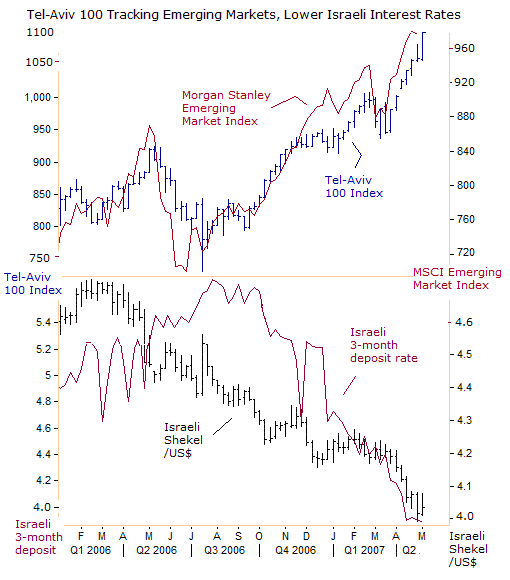
But while the ancient Hebrew prophet Samson's power was linked to his long hair, today's Israeli economy is powered by its technological supremacy and self-sufficiency. That's enabled the Tel-Aviv-100 and over 120 Israeli listed shares on Nasdaq to be grouped with emerging economic giants such as Brazil, China, India, and Russia within the Morgan Stanley Emerging Market Index.
Relative to the size of her population, Israel has more engineers, and sees more scientific articles published, than any other country in the world (Israel has 135 engineers per 10,000 people, the US has 85). Cisco Systems, Motorola, Intel, IBM, Nortel, Microsoft, Mitsubishi, Deutsche Telekom, aviation and space companies, have set up subsidiaries and research centers in the country, and invested in Israeli technology incubators, venture capital funds, or strategic partners.
Israel has more technology patents registered in the United States, than China, Russia, and India combined. Intel has been active in Israel for more than 30 years with annual exports of $2 billion, and more than 5,000 workers. Intel is building a second $4 billion chip plant in Kiryat Gat alongside an existing plant that is expected to come online in the second half of 2008. Intel's Centrino processing chip and the Pentium II was developed with significant input from Israeli engineers.
The Given Imaging's diagnostic pill-cam, the Arrow, the world's most advanced anti-missile missile, MRI's and CAT scans, dental and medical imaging devices that are used around the world, drip irrigation, and text messaging were developed in Israel. The percentage of high-tech exports as a percentage of its total exports has been steadily increasing, from 45% in 1995 to 60% in 2006, when Israel recorded a balance of payments surplus for the first time.
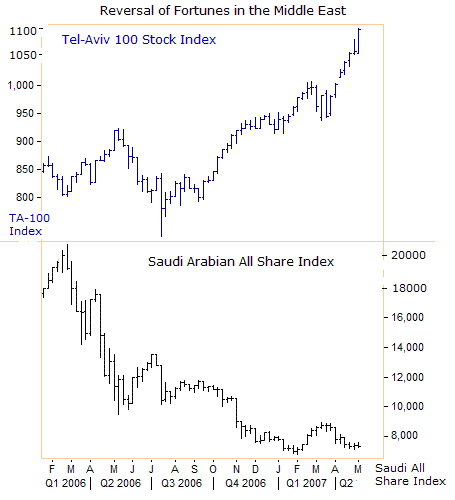
Israel has few natural resources, unlike Saudi Arabia which contains the world's largest crude oil reserves. Instead, high-tech consultation services from Israel to foreign businesses climbed 10% to $19.3 billion last year, or 31% of total exports in 2006. In large part, Israel's high-tech industries are a spin-off from its need to maintain a qualitative military edge over her potential enemies, in a very hostile neighborhood. Israel was the first to develop pilot-less drones and is one of only six countries around the world that can launch its own satellites.
Yet while seventy Saudi Arabian princes control 70% of the Saudi All Share Index, twelve Israeli business groups control 60% of the market value of all Israeli public companies, excluding Teva Pharmaceutical. The groups control pyramids, with top-level holding companies controlling different groups of companies through descending layers of ownership. Such oligarch arrangements were eliminated in the US in the early 20th century through restrictions on ownership and the double taxation of dividends a company paid its owner company.
The 12 Oligarchs have an inordinate amount of control over Israel's economy, its political leaders and the media, and fear the return of Netanyahu as prime minister, who makes no secret about following the reform path taken by British Prime Minister Margaret Thatcher in the 1980's. If Olmert's government is toppled in the months ahead, polls show Netanyahu's Likud gaining 33 seats compared to Kadima capturing 16 seats. “Israel has a chance at making fairly significant advances in the future if it sticks to and expands its private markets,” said Alan Greenspan on Dec 11th, 2006.
On January 20, 2007, the leader of Lebanon's Hezbollah movement Sheikh Hassan Nasrallah predicted the resignation of Israeli Prime Minister Ehud Olmert and Defense Minister Amir Peretz. “This war is not a failure for Olmert's cabinet only, but the failure of a major political party in Israel, the Kadima party and its main coalition partner, Labor. The moment I heard of IDF chief od staff Halutz's resignation I was filled with joy. His resignation was anticipated. Peretz will follow, as will Olmert. Whoever does not resign, will be dismissed,” Nasrallah declared.
Israeli opinion polls also show that 70% of the public believe Iran will acquire nuclear weapons in the years ahead, and 75% believe that Iran will use them. “Like it or not, the Zionist regime is heading toward annihilation. The Zionist regime is a rotten, dried tree that will be eliminated by one storm,” warned Iran's president, Mahmoud Ahmadinejad on April 15, 2006.
On February 19, 2007, IAEA chief Mohamed ElBaradei confirmed that Iran has mastered crucial nuclear technology to enrich uranium on an industrial scale as early as this August, at its nuclear facility in Natanz.
 That's led to speculation in Israel that sometime in August, US President George Bush will decide whether or not to launch a large-scale military assault against Iran. Russian Col.-Gen. Leonid Ivashov, vice president of the Academy of Geopolitical Sciences, said on March 27th, that the Pentagon is planning to deliver a massive air strike on Iran's military infrastructure in the near future, “that would enable the Americans to bring Iran to its knees at minimal cost.”
He also said the US Naval presence in the Persian Gulf has for the first time in the past four years reached the level that existed shortly before the invasion of Iraq in March 2003. The USS John C. Stennis, with a crew of 3,200 and around 80 fixed-wing aircraft, including F/A-18 Hornet and Super-hornet fighter-bombers, eight support ships and four nuclear submarines are heading for the Gulf, where a similar group led by the USS Dwight Eisenhower has been deployed since December 2006. The US has also Patriot anti-missile systems to the region.
Which ever way the wind blows, only 8% of Israelis polled said they would consider leaving the country if Iran does get the bomb. The Iranian nuclear threat hasn't stopped the flood of foreign investment into Israel which equaled two-thirds of the net investment in Russia and one-third into China last year, and is still powering the shekel and Israeli stocks higher. South Korea's tiger economy also prospered with booming exports under the shadow of a nuclear Pyongyang for the past five years.
Is Iran's Ahmadinejad just another hothead, all bark and no bite, and simply aiming to jawbone oil prices as high as possible? Ninety-five percent of Iran's foreign exchange earnings are linked to oil sales. And Tehran's steadfast allies in the Kremlin and Caracas are also profiting handsomely from the tension in the Middle East.
Instead, global investors share the views of Shimon Peres, the political insider of the Oligarchs, who sees little chance of an armed conflict in the Persian Gulf. “The US has managed, via economic leverage, to counter the threat of nuclear weapons in Libya, the Ukraine, South Africa, and now North Korea. It's not impossible that the same could happen in Iran, which is a poor, weakened nation,” Peres said.
Likud chief Netanyahu has also called on the world to stop Iran's nuclear ambitions in its tracks by imposing sanctions on the Tehran regime. “I want to call on the world that didn't stop the Holocaust last time to stop any attempt this time and what needs to be done is divest from genocide. The moment the snowball of voluntary economic sanctions begins, the pressure on Iran will be immense,” he added. But none of Iran's major trading partners are listening to the lone voice in the woods.
 But when it comes to predicting the future of the “Incredible” Israeli shekel, and a possible future confrontation between Israel and the Ayatollah of Iran, perhaps it's best to refer to the Biblical scriptures for insight. The prophet Job once remarked, “The divine intelligence is beyond us and God's ways are inscrutable. We simply cannot understand them all no matter how high the level of our wisdom.”
By Gary Dorsch,
Editor, Global Money Trends newsletter
Here's what you will receive with a subscription, Insightful analysis and predictions for the (1) top dozen stock markets around the world, Exchange Traded Funds, and US home-builder indexes (2) Commodities such as crude oil, copper, gold, silver, the DJ Commodity Index, and gold mining and oil company indexes (3) Foreign currencies such as, the Australian dollar, British pound, Euro, Japanese yen, and Canadian dollar (4) Libor interest rates, global bond markets and central bank monetary policies, (5) Central banker "Jawboning" and Intervention techniques that move markets.
GMT filters important news and information into (1) bullet-point, easy to understand analysis, (2) featuring "Inter-Market Technical Analysis" that visually displays the dynamic inter-relationships between foreign currencies, commodities, interest rates and the stock markets from a dozen key countries around the world. Also included are (3) charts of key economic statistics of foreign countries that move markets.
A subscription to Global Money Trends is offered at only $140 US dollars per year for “44 weekly issues”, including access to all back issues. Click on the following hyperlink, to order now, http://www.sirchartsalot.com/newsletters.php Call toll free from USA to order, Sunday thru Thursday, 2 am to 4 pm EST, at 866-576-7872.
Mr Dorsch worked on the trading floor of the Chicago Mercantile Exchange for nine years as the chief Financial Futures Analyst for three clearing firms, Oppenheimer Rouse Futures Inc, GH Miller and Company, and a commodity fund at the LNS Financial Group.
As a transactional broker for Charles Schwab's Global Investment Services department, Mr Dorsch handled thousands of customer trades in 45 stock exchanges around the world, including Australia, Canada, Japan, Hong Kong, the Euro zone, London, Toronto, South Africa, Mexico, and New Zealand, and Canadian oil trusts, ADR's and Exchange Traded Funds.
He wrote a weekly newsletter from 2000 thru September 2005 called, "Foreign Currency Trends" for Charles Schwab's Global Investment department, featuring inter-market technical analysis, to understand the dynamic inter-relationships between the foreign exchange, global bond and stock markets, and key industrial commodities.
Copyright © 2005-2007 SirChartsAlot, Inc. All rights reserved.
Disclaimer: SirChartsAlot.com's analysis and insights are based upon data gathered by it from various sources believed to be reliable, complete and accurate. However, no guarantee is made by SirChartsAlot.com as to the reliability, completeness and accuracy of the data so analyzed. SirChartsAlot.com is in the business of gathering information, analyzing it and disseminating the analysis for informational and educational purposes only. SirChartsAlot.com attempts to analyze trends, not make recommendations. All statements and expressions are the opinion of SirChartsAlot.com and are not meant to be investment advice or solicitation or recommendation to establish market positions. Our opinions are subject to change without notice. SirChartsAlot.com strongly advises readers to conduct thorough research relevant to decisions and verify facts from various independent sources.
© 2005-2022 http://www.MarketOracle.co.uk - The Market Oracle is a FREE Daily Financial Markets Analysis & Forecasting online publication.
